
RAG-Powered Market Intelligence Chatbot
-
Company
Novertur International SA
-
Company link
Problem definition
Modern business intelligence platforms such as Business Monitor aggregate extensive public and private data sources into a highly comprehensive corporate database. While the platform enables structured keyword search and multi-parameter filtering, extracting precise, decision-ready insights remains a largely manual workflow.
Users must translate complex business questions into combinations of industry codes, geographic filters, and relational attributes. The results are then exported as Excel files and analyzed offline to derive conclusions. This workflow introduces friction, slows strategic decision-making, and increases cognitive load — particularly for highly specific, localized, or multi-constraint queries.
In short, the platform is data-rich but interaction-limited: it provides structured access to information, yet lacks an intelligent interface capable of synthesizing insights directly from the underlying data.
My solution
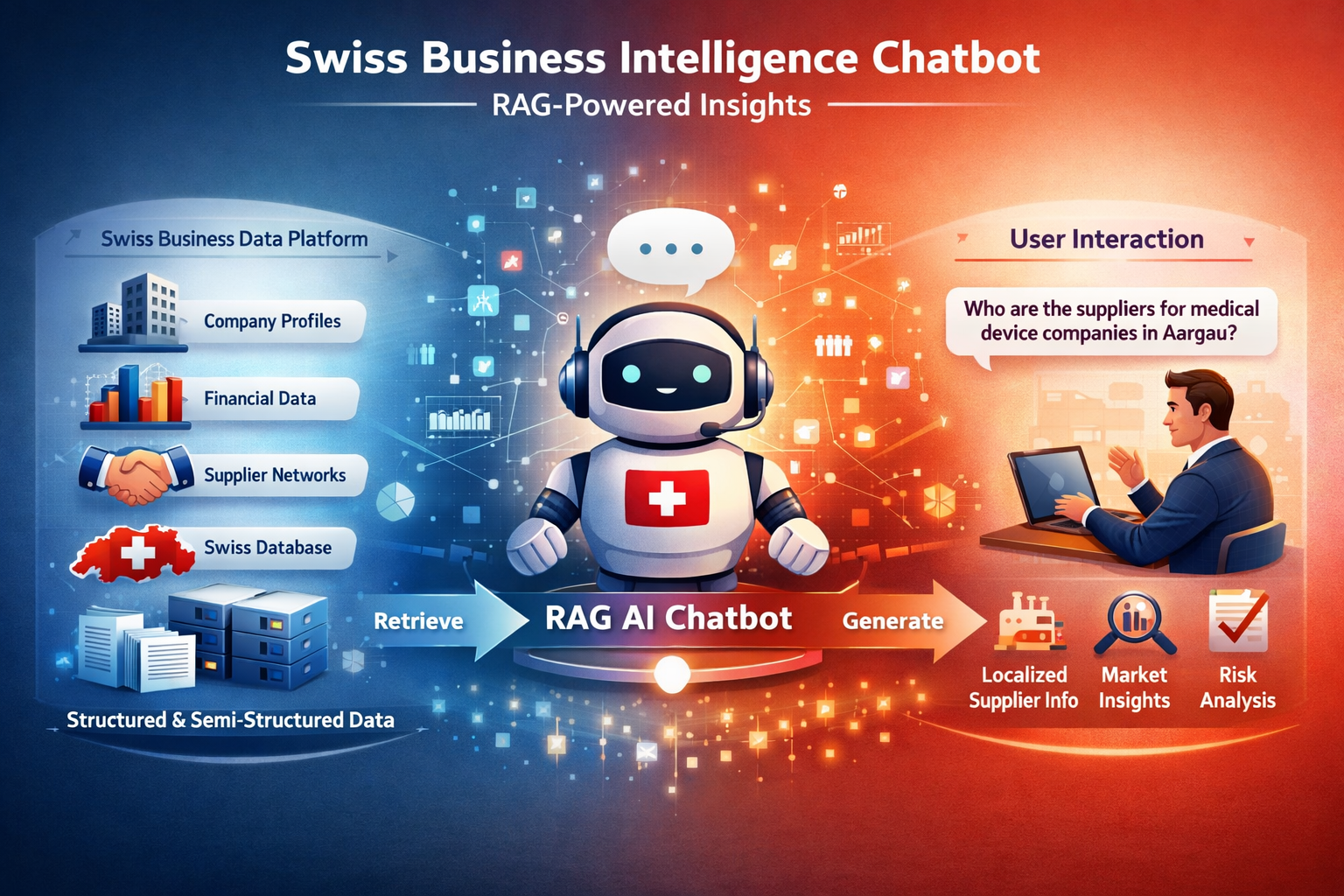
This project introduces a Retrieval-Augmented Generation (RAG) conversational intelligence layer on top of the structured corporate dataset. Instead of relying solely on static filters and spreadsheet exports, users can interact with the data through natural language queries and receive context-aware, synthesized answers in real time.
The solution indexes company profiles, financial indicators, supplier relationships, industry classifications, and geographic metadata into a semantic retrieval system. User queries are converted into vector representations, enabling precise contextual retrieval across structured and semi-structured records. A large language model (LLM) then synthesizes the retrieved evidence into concise, business-ready insights.
This architecture transforms static data exploration into dynamic analytical dialogue — enabling users to ask highly localized and specific questions such as supplier network strength, regional industry structure, or dependency concentration, and receive actionable intelligence instantly rather than manually constructing it through iterative filtering and offline analysis.
The current implementation is focused on Swiss companies, ensuring high-resolution regional analysis and localized supplier network intelligence. The architecture is designed to be modular and scalable, allowing seamless expansion to broader European datasets in future phases.